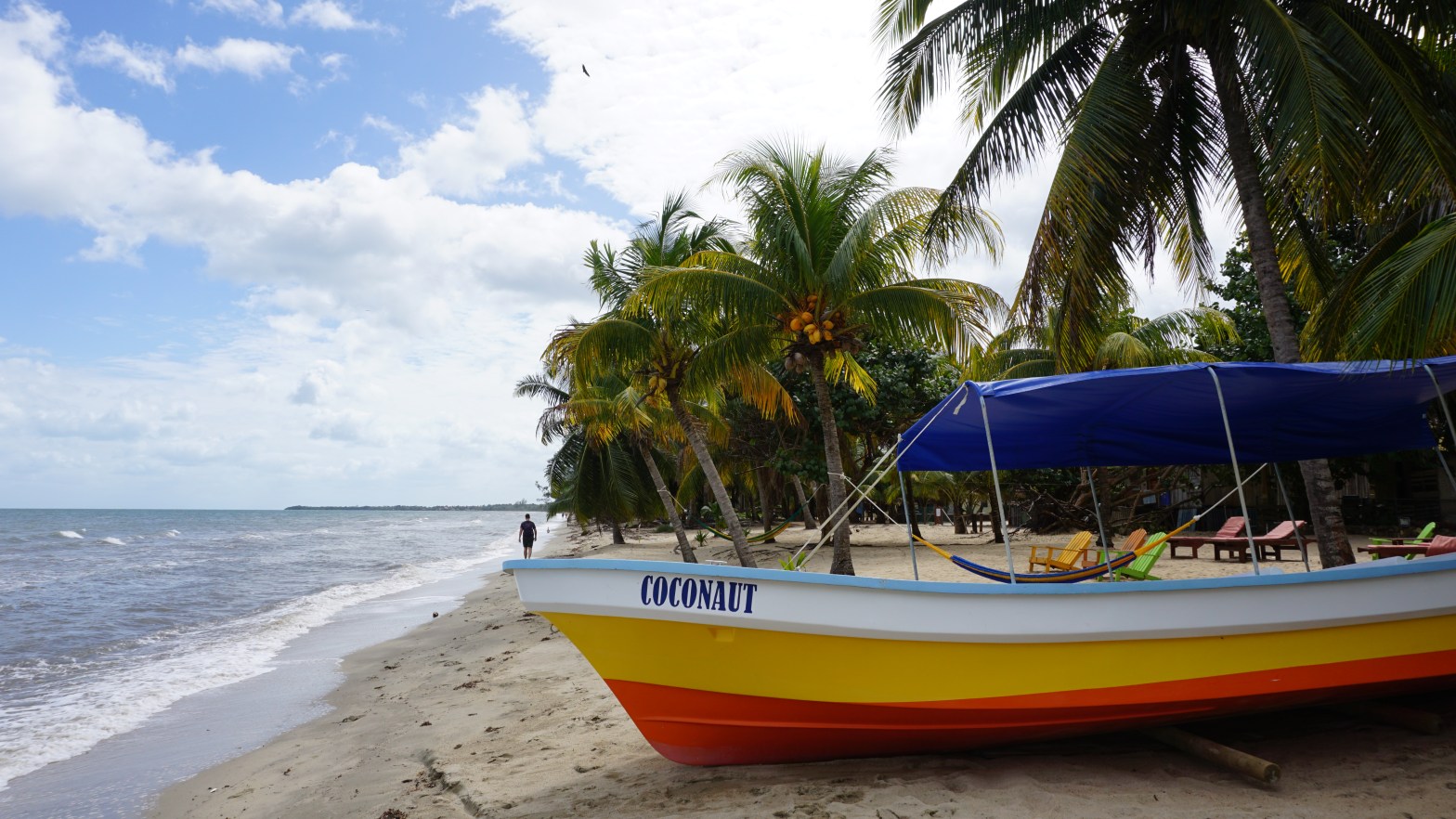
We had no idea what to expect with Belize, a small country which is mostly known for its small islands. We veered off the typical tourist trail and were blown away by its beautiful landscapes, proud people and rich culture.
What we’ve learnt in Belize:
- Plantain chips aka Ghetto Pringles are delicious.
- Belize is small in size but abundantly diverse. We’ve experienced a proud Maya culture in Northern Belize and we’ve seen how the Garifunais bring life and soul along the coast. There is a big Chinese population – originally brought over in the 19th century to work in the sugar cane plantations, they now run most of the supermarkets. We’ve also encountered Mennonite communities (often confused with the Amish) who are responsible for the majority of Belize’s produce and dairy.
- The Belize Barrier Reef is the second-largest barrier reef in the world.
- The official language is English (our Spanish learning took a back seat) but Kriol tends to be the language that that most Belizians speak.
- That beautiful pink shell you associate with exotic locations is a Belizian delicacy called Conch.
- Formerly a British colony, its influence is still apparent with coins featuring the Queen and the funny names of its towns: Double Head Cabbage, Spanish Lookout, Teakettle, Bullet Tree Falls and Valley of Peace.
CAYE CAULKER
We arrived in Belize via boat from Mexico, ready for some rum and island life. Caye Caulker is a small island whose motto ‘Go Slow’ is to be taken very seriously. Everything moves at a slower, chilled-out pace. Bikes and golf carts are used in favour of cars (although the golf carts are powered by diesel) and your food order will come at its own rate.

The sea is beautiful with multiple hues of blue, showcasing a kaleidoscope of colour. The streets are lined with seafood BBQs, reggae loving locals and barefoot foreigners. We had our first dinner at Wish Willy’s, a laid back no-fuss eatery compromising of a BBQ in his sandy front yard with self-serve beer from a cool box. We left happy with our bellies full of shrimp, lobster and Belkin beer.
We didn’t have much luck with the weather, one sunny day compromised by three days of rain. Usually not a problem but it doesn’t leave much to do on a small beach island!


We spent a day snorkelling with Caveman Tours. We took the boat out of the barrier reef and stopped at multiple sites including the Hol Chan Marine Reserve. We were lucky to swim with some amazing sealife – Harvey came face to face with a turtle as it came up for air and sting rays were spotted among colourful fish. We dove into Shark Alley where we swam with nurse sharks as they were being fed by the boat.


ORANGE WALK & LAMANAI
We took the recommendation to visit Orange Walk from a couple we met in Bacalar. This last minute addition to our itinerary turned out to be the highlight of Belize for us.
Based in Northern Belize, Orange Walk is known as ‘Sugar City’ due to its large factory and vast sugar cane fields. Most of the molasses and sugar are exported and some of it is transformed into rum in the nearby distilleries. No exageration, the air is saturated with sweet smells of sugar and rum! Sitting by the water in our hotel, we were also covered in ash transported in the air from the sugar cane burning in the nearby factory.


We stayed in a family run riverside lodge, a beautiful little oasis for bird and crocodile watching. The owner Mr. P would call us to the edge of the water with his binoculars ,to show us the crocodiles hiding across the water. He’s very passionate about crocodiles and has caught 156 of the reptiles over fifteen years with just a mask and rope! After catching them, he would check their health, tag them and give them a name. That’s why the river is full of Raouls , Joses and Marias!


One of the main attractions in Orange Walk is a visit to the ancient Maya city of Lamanai, which can only be reached via a two-hour boat ride up the New River. The river is rich in wildlife and our guide Eric took the time to show us everything there was to see: iguanas, bats, crocodiles, howler monkeys and an array of birds.


Only a few groups of people were there, it felt like we had the whole place to ourselves, a vast contrast to our visit to Chichen Itza! The site is surrounded by abundant rainforest with ruins hidden around every corner. Only 5% of the site has been excavated with imposing structures exposed such as Jaguar Temple, Mask Temple, and High Temple.
Lamanai is known to be the longest occupied Maya site. Whilst most sites were abandoned around the 10th century, Lamanai continued to thrive up until the 16th century when the Spanish came to Belize. With their arrival, they built two churches over Mayan temples with the aim to convert the people to Christianity. A century later, the Maya renounced their new faith and in revolt burned the churches. They have known to have continued to occupy Lamanai until the 18th century.


Orange Walk was also the time that Harvey decided he wanted to shave his head. We suddenly regretted our decision to attempt it ourselves with his beard trimmer and swiftly moved into town to find a barbershop. We had forgotten that Harvey was wearing a tank top, as the barber removed his apron he transformed into a thug. After minutes of walking out of the barbershop, he was approached a local who asked Harvey ‘are you looking for a fight?’. After this, the tank top didn’t make an appearance for some time!


HOPKINS
Mr. P had urgent business in Belmopan so offered to give us a lift to the city where we would continue to Hopkins. On the drive down, Mr. P pointed out the country’s only prison, Belize Central Prison. We were so close we could see the inmates in their orange overalls working in the facility’s factory just metres away, we even got a few waves! Mr. P proudly informed us that it’s managed by a non-governmental organisation called The Kolby Foundation, which puts a huge focus on the rehabilitation of its inmates. Part of this is achieved through the development of skills that transfer to the outside world. What inmates produce (sheds, coffins, tables…) within the prison is sold in the gift shop, with the aim is to use these funds to support the maintenance of the prison. The entrance displayed a Nelson Mandela quote ‘A nation should not be judged by how it treats its highest citizens, but its lowest ones”.

What you see is what you get, Hopkins is an unpretentious, laid back fishing village that sits at the end of a dusty road. So far the town has resisted the commercialisation seen in Caye Caulker and offers a friendly and quiet stay.
Primarily inhabited by the Garifuna, it’s the perfect place to soak up their culture. The Garifuna are Afro-Carribean, descendants from African slaves and Carribean islanders. We took a glimpse into this culture with a night of drumming and dancing as well as sampled their food, fish cooked in coconut milk with plantain.


Hopkins is also the ideal gateway to the Belize Barrier Reef. We spent a day with Captain Ash and his buddy Jon in search of some good snorkeling and spearfishing. The reef felt very secluded and preserved compared with the overcrowded snorkelling we experienced in Caye Caulker.
We reached a collection of Cayes and took our first plunge along a channel in the reef. Jon showed us how to catch lobster with nothing but a long hook and a deep breath.


Whilst we continued to hunt for our lunch, Captain Ash enthusiastically swam ahead with a speargun and his catch of hogfish nestled in the leg of his wetsuit. We watched him attempt to catch a barracuda before he faded back into the distance. He was so caught up with his hunting that he left us to drift in what was becoming a choppy swell. Fortunately, Jon waved down a passing fishing boat and we were lifted onto the boat with our arms filled with five conchs, two lobsters and a crab. The boat was chartered by two miserable tourists which didn’t give us the warmest welcome! We later learned that the boat had been chartered for thousands of dollars and they were yet to make their catch. Given that we have emerged on the boat with our fruitful catch, their rudeness suddenly made sense!


We rejoined our boat and made our way to Bread and Butter Caye, a small privately owned island where we prepared our catch and lit a BBQ.


As a place promoted as a beach destination, we were disappointed by the state of the shores of mainland Hopkins – you could fill a skip full of odd flip flops! The sea brings up a lot of rubbish and the few hotels dotted around ensure their area is spotless. Sadly, the stretches of beach in between are left to be. We decided to do something about it and gathered a few people from our hostel for a beach clean up.
Despite the discouraging knowledge that a new wave of plastic was likely to wash up the following day, our efforts were not in vain, as each and every one of us will think twice the next time we’re offered a plastic straw in a restaurant or a plastic bag in a shop.
The government has also approved legislation to phase out of single-use plastic and styrofoam. The transition is very much in progress however local businesses are on board and optimistic.


SAN IGNACIO
After three chicken buses crammed in between the locals, we arrived in San Ignacio. The town is a popular stop over for people coming to and from Guatemala.


We visited the Green Iguana Conservation Project whose mission is to increase and protect the iguanas which are under threat. The humble iguana is also known by locals as ‘bamboo chicken’ due to its delicacy status. Later in our trip, we showed our iguana photos to a Guatemalan who exclaimed ‘yummy!’
The conservation finds eggs in the wild and brings them to the sanctuary to give them the best chance of survival, until they are old enough to be released. They also rehabilitate injured iguanas and give them a permanent home.
We were given the chance to step inside the sanctuary and immerse ourselves with the iguanas. When threatened, an iguana defends itself with a bite or a bat of the tail, however, we were assured this wouldn’t happen as they’re used to human contact. Too close for comfort, Hannah decided to stand this oneout but was suddenly confronted by the daddy of all iguanas which appeared outside the cage. It was mating season and the cage full of unreachable females was too much for him.


Sunday’s are famous for San Ignacio’s market. Belizians come from all over to sell and buy their produce. We got stuck in to enjoy some traditional street food for breakfast: garnaches (fried corn tortillas topped with refried beans, shredded cabbage and cheese) and fish panades (corn tortilla folded in half with smoked fish filling, beans and cheese).


We learnt that there has been a long-standing territorial dispute between Guatemala and Belize. Guatemala doesn’t accept the boundaries set during the British colonisation and Belize’s subsequent independence, therefore, is claiming half of Belize’s territory. Both countries have recently voted yes in a referendum to take the matter to the International Court of Justice. It is strongly believed that Belize will win and they are confident that the British have the necessary documentation to support this.

Next stop: Guatemala!
 Travel Blog