The first part of our trip was spent exploring the Yucutan Peninsula, barely scratching the surface of what Mexico had to offer. We spent two weeks immersing ourselves into a new way of life and getting out of our comfort zone!
What we’ve learnt in Mexico:
- You can put anything in a tortilla.
- When a Mexican tells you something is spicy, put pride aside and do not ingest.
- The history of the ancient Maya’s is fascinating – they were trailblazing astronomers, early adopters of mathematics and developed their own hieroglyph language.
- Perceived as a civilisation that is now long gone, the Maya continue to thrive.
- The Spanish influenced colonial architecture is present. It’s a stark reminder of the past where Indigenous Maya people were faced with the invasion of the Spaniards, leading to bloodshed.
- The less frequented towns of Merida, Valladollid and Izamal offer an authentic Mexican experience and a glimpse into Mexico’s historical, natural and cultural treasures.
- There is such a thing as too many margaritas.
- Mezcal (tequila’s smokier cousin) should be sipped not shot. It’s best enjoyed with a bite out of a slice of orange sprinkled with worm salt to cleanse the palate.
- The dead are worth celebrating.
CANCUN
We came, we saw, we fled.


TULUM
After a one night stopover in Cancun, we made our way to Tulum to spend New Year’s Eve with Hannah’s family.
We were based in Tulum town centre as we wanted to stay with the locals, be close to real Mexican food and escape the pretentious vibe of Tulum beach. This fantasy was short-lived as we found out our accommodation was at the back of a trendy smoothie bar; we had to navigate our way through the influencers and their smoothie bowls to get to our room!
We rented bicycles to get to the beach which was a few kms away. Harvey ended up with a rusty pair of wheels and challenged himself to get to the beach in one piece. We explored the northern beaches which so far have been shielded from significant development. It’s home to public beaches and a few smaller hotels and beach clubs, a stark contrast to the overbuilt southern side which has been taken over by a line of luxury resorts. We found a spot for the afternoon, taking in the white sand and turquoise waters with a side of guacamole and margaritas.
We heard that Tulum was a backpacker’s paradise a few years ago, however, it’s gone through a huge amount of gentrification to cater to tourism. We were left disappointed with the hype around Tulum, it felt we were in bubble that didn’t feel like Mexico. The beaches were picture-perfect, the margaritas were tasty but sadly Tulum didn’t live up to our expectations.


VALLADOLID
We moved inland in search of a more authentic Mexican experience and we weren’t disappointed. Valladolid is still off the beaten path so it was a breath of fresh air after the heavily touristy Tulum.
Valladolid is what you would expect a Mexican town to look like: pastel-coloured colonial houses, a little square overlooking Catedral de San Servasio where locals congregate and taco stands on every corner. The cathedral was built on top of a demolished Mayan Pyramid and some of its stones were used to build it.


We spent our first night indulging in some Maya cuisine at IX CAT IK, a restaurant run by a family that prides itself on sharing and maintaining their culture through food. We were shown around their garden and taught the medicinal powers of their plants (we were offered a welcome drink brewed from Chaya leaves from the garden). We learned that oregano, cinnamon, pepper, garlic and chili forms the basis of all Maya dishes, and that each corn tortilla is carefully hand made. Harvey helped grind the cocoa beans which were used to make our chocolate dessert.


The Yucatan Peninsula is scattered with ancient Maya ruins and cenotes, which are sinkholes filled with freshwater. Both represent a civilisation that thrived thousands of years ago and, whose culture and people are still very much at the heart of the region.
Cenotes were a sacred place for the Maya, they were their water source and played a central role in their religious beliefs. Some say the Maya believed that cenotes were the entrance to the underworld, enabling them to communicate with the gods and their ancestors. It’s no surprise that offerings were found at the bottom of the water.
In search of a spot to cool down for the afternoon, we rented a scooter to visit Cenote Oxman – an open cenote with a collapsed roof and hanging roots crawling down the walls. The drive took us through farmlands and bumpy dirt roads, where we were chased by a pack of dogs and spotted vultures feasting on a carcass – all part of the adventure!


We got up early to visit Chichen Itza, which is considered the most famous Maya ruins and one of the New Seven Wonders of the World. Unsurprisingly, Mexican highways and scooters are not friends so we arrived windswept and with sore bums. We walked around the iconic pyramid and were finished by the time the buses full of tourists from Cancun and Tulum started to arrive.


On our drive back, we avoided the motorway in favour of a more scenic and calmer route via some local villages. We stopped at Uayma which is home to the most beautiful church, it was built by the Spanish with stones from nearby Mayan temples (including Chichen Itza) and was later burned down by the Maya in their revolt against the Spanish. Thankfully, it was restored in 2003 to its former glory. We arrived during their Sunday service so we were only able to peek our heads in!


IZAMAL
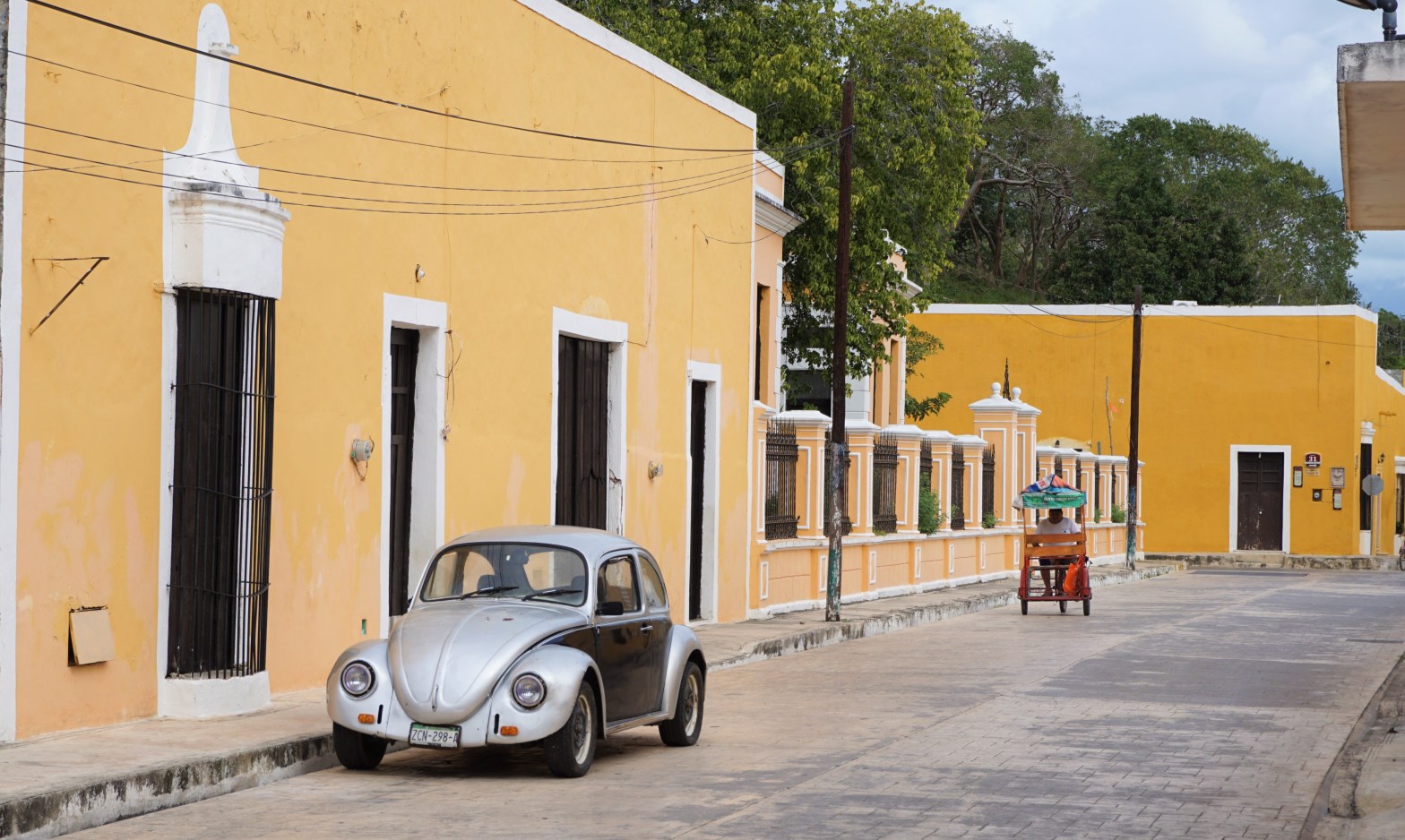
On our way to Merida, we stopped over at the sleepy town of Izamal, a bright yellow colonial town centered around the Convento de San Antonio de Padua. As soon as you get off the bus, you are surrounded by bright egg-yolk yellow walls on every street you encounter.


Evidence of the Maya is still present with pyramids peaking through and providing viewpoints across the town. The Convent of San Antonio de Padua stands with its prominent height above the town due to it being built on top of a flattened Maya pyramid.


MERIDA
Our next stop was the capital city of Yucatan, Mérida, where we stayed in a little oasis nestled behind a rough exterior. The streets of Mérida are a blend of dilapidated buildings, peeling walls and restored pristine houses. The casual onlooker would have no idea that such beautiful homes lie behind these walls.
We spent most of our days wandering and exploring neighbourhoods, uncovering pretty roads and churches, with multiple taco pit stops along the way.


Paseo de Montejo is home to a long line of luxurious mansions that were built in the 19th century following an influx of wealth generated from the henequen (agave) trade. The street was inspired by the Parisian Champ Elysees and is now home to a blend of abandoned and restored mansions.


We visited Hacienda Mucuyché, an 18th-century henequen farm, which is home to two incredible cenotes. We stepped into the first semi-open cenote and followed a canal with growing vegetation down the walls to reach the second. We picked up a mask before silently entering a dark tunnel leading to the cavern where there were a few spotlights underwater to highlight the majestic abundance of stalactites and stalagmites. The cenotre water has been filtered through limestone and is beautifully crystal clear. The only natural light was from a well that we’d peaked through an hour earlier. Our guide invited us to meditate with him, taking a moment to lie on our backs, in complete silence and take in the healing powers of the virgin water.


Merida is famous for its cantinas which are bursting with locals and foreigners alike. It’s the perfect place to indulge in some live music, mezcal tastings,, watch the locals salsa and the foreigners awkwardly attempt. At La Negrita, the more you drink, the more free spicy snacks you receive.


BACALAR
After a six hour bus journey we arrived in Bacalar, which sits close to the border of Belize. It boasts a beautiful lagoon called the ‘Lagoon of Seven Colours’ due to its blue and turquoise hues that constantly change throughout the day.
Our accomodation was nestled out of town and on the edge of the lagoon – a peaceful little haven we would call home for the next few days. The ride there took us down a very bumpy road with many ‘for sale’ signs across patches of land – a sad indication that Bacalar could meet the same fate as Tulum.
The airbnb compromised of a few cabins scattered around the grounds. They were very basic with a simple curtain separating the bathroom from the bedroom – this tested our relationship as Harvey succumbed to ‘Montezuma’s revenge’ within hours.

When booking, we didn’t realise our hosts encouraged a strong communal vibe. The staff were ‘work away’ foreigners, staying a few weeks at a time living for free but helping out however they could (yoga, cooking, cleaning). Lunch and dinner were served on a long table with staff and guests, eating together and swapping stories. Harvey met a Serbian guy called Milan and jokingly asked if he knew his Serbian friend Ognjen. Despite the false assumption that all Serbians know each other, it turns out Milan and Ognjen went to school together and are good friends!


Next stop: Belize!
 Travel Blog